
GM friends.
Here’s what I’ll cover today:
🔍 The crypto reflexivity trade
📊 Crypto chart of the week
🗞️ The latest DeFi news
🔍 The crypto reflexivity trade
In today’s newsletter, I want to talk about reflexivity, which I think is one of the most useful concepts for better understanding financial markets.
The basic idea is that market prices aren’t driven only by fundamentals.
Investors form expectations about certain assets based not only on reality, but also on their perception of reality and what they expect to happen next.
For example, when BTC shows the first signs of strength after a bear market, more people start paying attention to it and buying it. This attracts even more capital and attention, creating a self-reinforcing loop that eventually drives the price much higher.
BTC’s fundamentals don’t necessarily improve just because its price goes up, but people’s perception of BTC can improve as its price keeps rising.
This seems to be happening now with BTC’s latest major rally from $63k to $83k+, and we saw similar dynamics in previous cycles after the bottom was in.
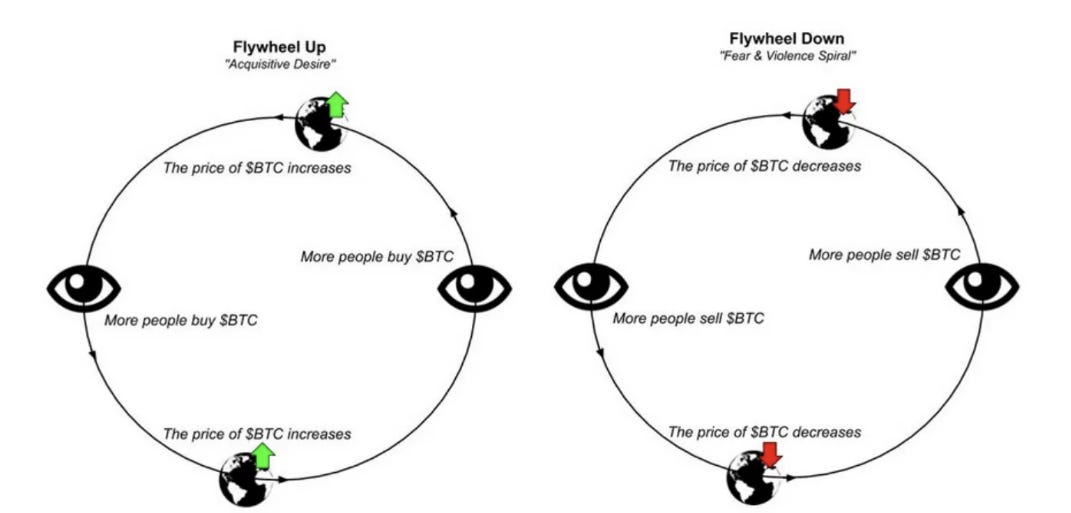
Basically, as prices go up, significantly more people jump on the trend and start believing that the uptrend will continue.
Ok, so why does all this matter?
Well, I think understanding reflexivity can help you become a better trader.
Almost all crypto assets are reflexive to some degree, but I would argue some are way more reflexive than others, and the latter tend to outperform.
I would broadly categorize crypto assets into 2 groups:
Assets whose reflexivity is based purely on attention (e.g. BTC) - BTC goes up → more people notice it and buy it → BTC goes up → even more people buy it
As the price rises, a positive feedback loop develops and drives more demand, but the fundamentals of BTC don’t directly improve just because its price is higher.
Assets with both attention-based reflexivity and economic reflexivity - I would give AAVE or ENA as examples here.
As the market starts going up, altcoins in general, including AAVE or ENA, obviously get more attention, which is ultimately beneficial for their price action.
But on top of that, the fundamentals of certain altcoins also improve.
How?
In Aave’s case, for example, higher crypto prices lead to more TVL as the value of the collateral deposited on Aave rises, which also increases the protocol revenue.
In Ethena’s case, higher crypto prices lead to higher funding rates, which lead to a higher sUSDe yield, more sUSDe demand, and ultimately more revenue for Ethena.
This creates a much stronger reflexive mechanism:
Price goes up → the project gets more attention → the protocol usage and revenue increase → price goes up further
By economic reflexivity, I mean that the same market conditions driving a token higher can also improve the economics of the underlying protocol.
This is important because a token becoming more expensive doesn’t necessarily mean it is becoming more overvalued if the fundamentals are improving at the same time.
This may help explain why tokens like AAVE and ENA have outperformed most altcoins over the past 2 months. They benefited not only from the broader market rally and increased attention, but also from improving protocol metrics.
Some assets like BTC are reflexive primarily because their rising prices attract more demand.
Others are reflexive because higher prices also improve their fundamentals on top of attracting more demand, and I think those are likely to perform best in a bull run.
Now, just to clarify, this doesn’t make BTC a bad investment.
BTC is actually my biggest holding rn, as I see it as the lowest-risk crypto investment.
But if we're talking about altcoins, for me it makes sense to bet mostly on tokens that also benefit from economic reflexivity, as described above, because I think those have much greater potential to outperform the market.
How do you identify these kinds of opportunities?
I covered AAVE and ENA as two examples of highly reflexive assets, but I also want to share my general framework for finding other opportunities like this.
A good way to start is with a market thesis and then work backwards.
If you think BTC will continue going up, then ask yourself which protocols are likely to see the biggest surge in revenue because of it. Or if you think on-chain trading activity will rise, look for projects that would directly benefit from higher volumes.
Off the top of my head, these are a few general crypto categories that I believe could perform very well in a bull run:
DEXs - higher speculation → more trading volume → more DEX fees and revenue
Stablecoin protocols - the total stablecoin supply surged to new ATHs and beyond in all previous bull markets, and I don’t think this time is different
Lending protocols - higher asset prices → higher collateral values → more borrowing as the demand for leverage rises → more revenue
There are other categories as well, but I’d say these are among the most obvious ones.
DeFiLlama has a helpful section called “https://defillama.com/categories” that makes it easy to see the market leaders in each sector.

My suggestion for anyone looking for highly reflexive altcoins is to go through each sector you are bullish on using DeFiLlama and identify the projects you find most compelling from an investment perspective.
Look at their tokenomics, business model, competitors, recent growth, team track record, and, most importantly, think about how their revenue and usage would change if your market thesis plays out.
The whole idea behind economic reflexivity in crypto is simple:
You are not just trying to randomly predict which token goes up. You are looking for protocols where the market pump itself improves their fundamentals, and where those improving fundamentals can then lead to even higher prices.
Used right, I think this can be a very useful framework for identifying outperformers.
Chart of the week
The total crypto revenue shared with token holders hit a new annual high in September 2026

Crypto meme of the week😂

The latest developments in DeFi
EtherFi introduced its own stablecoin powered by Ethena
Lido revealed Lido Lending, its own lending platform
Lighter announced the pre-market listing of the Variational token
Hyperliquid’s $200M annual revenue-sharing deal with Circle went live
Derive v3, an improved on-chain options trading platform, went live
Polymarket CEO said they’re “exploring an on-chain asset tied to Polymarket’s economy”, but without giving a launch timeline
Superform introduced Earn Stocks - DeFi yield strategies for tokenized stocks
Aptos introduced MonoMove - its biggest network scalability upgrade to date
Tenero V2, an upgraded Bitcoin DeFi analytics platform, went live
Ondo Finance launched a platform bringing tokenized pre-IPOs on-chain
Arbitrum is adopting USDG as its ecosystem dollar, with the revenue from USDG reserves flowing back into the Arbitrum ecosystem
Virtuals introduced Virtual App - a personal AI app with access to markets
Blast and Abstract announced they are shutting down
Sanctum burned 25% of its total token supply
Orca and Loopscale merged into a new project called Formation
That’s all for this week!
Until next time,
The DeFi Investor
Want to sponsor this newsletter?
Please send me a DM on Twitter (X). I have a sponsorship deck that I can send you.