

It’s no secret that some of the best DeFi airdrops came from perps DEXs.
Hyperliquid is well known for the biggest airdrop of all time, but many other perps DEXs like Lighter and dYdX also airdropped massive amounts of money.
For me, the biggest airdrop I ever got came from Lighter last year.
And as the valuations of perps DEXs have recently started rising again in pre-markets, I believe it still makes a lot of sense to farm their airdrops in 2026.
In this issue, I cover:
How to arbitrage funding rates to farm perps airdrops
My strategy to identify arbitrage opportunities
A free tool I am using to easily monitor my arbitrage positions
How I picked which perps DEXs to farm
A few risk management tips
I also talked about funding rate arbitrage last year, but my strategy changed a lot since then, and I started using new tools, so I decided to share an update.
Let’s dive in 👇
Funding rate arbitrage: How and why I use this strategy
First of all, if you are unfamiliar with funding rate arbitrage, here’s an intro:
When you open a long or short position on a perps DEX, you either pay or receive a small payment called funding rate at fixed intervals (every 1 to 8 hours).
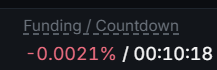
Every major perps DEX uses a funding rate mechanism.
When there are more shorts than longs, the people with long positions receive the funding rate payment. When there are more longs than shorts, the opposite happens.
Positive funding rates mean short positions get paid, while negative funding rates mean long positions get paid.
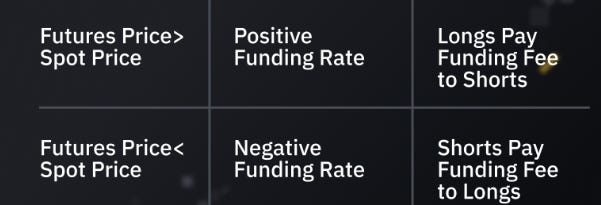
And these funding rates differ from exchange to exchange.
This creates an arbitrage opportunity: on one exchange, you might be paid to long BTC, while on another exchange, you might be paid to short it.
In these cases, you can open a delta-neutral BTC position between these exchanges and earn a nice yield from the positive funding rate spread. And that’s how funding rate arbitrage works.
With this strategy, I’ve been earning an average APR of 14% on my perps portfolio with a ~2x cross-margin account leverage over the past few months.
That said, the most valuable thing I get from funding rate arbitrage is perps airdrop points, as I am arbitraging funding rates only between perps DEXs.
I believe the points of certain perps DEXs like Variational could be worth a lot of money at TGE, which is the main reason why I arbitrage funding rates.
The best part about this strategy is that you can get a lot of points while being delta-neutral and not having to bet that prices will go in a certain direction.
How I identify funding rate arbitrage opportunities
The tool I’ve been using for this lately is bendbasis.com. I’ll show you how to use it.
There are many funding rate analytics platforms, but I’ve been using Bendbasis because it offers a lot of cool features you can’t find elsewhere.
An example is Bendbasis’s “Funding Arbitrage” dashboard, which you can access for free at bendbasis.com/arbitrage.
Once you get to this page, there are a few things I suggest doing:
At “Exchanges”, select only the perps DEXs you intend to farm (for example, I selected Hyperliquid, Variational, and Extended)
At “Filters” → “Min Open Interest”, select a minimum open interest between $150k-$700k depending on the size of your portfolio
Then click on “APR” to see the top arbitrage opportunities by APR

After you do this, Bendbasis will show the top funding rate arbitrage opportunities by 15-day APR, rather than by live APR, as most other tools do.
This matters because, ideally, you want to find arbitrage opportunities with a stable, positive funding rate spread so you don’t have to constantly rotate your positions.
This dashboard also features a “Stability” indicator on the right side of the page. The greener the indicator, the more reliable the spread has been over time.
An example of a good funding arbitrage opportunity at the time of writing is a delta-neutral ATOM position between Hyperliquid and Variational.
(long ATOM on Hyperliquid while shorting it on Variational)

To see how this position performed in the past 30 days, you can click on it on Bendbasis directly from the Funding Arbitrage page.

This will open a historical ATOM funding rate chart like the one above.
As this chart shows, over the past 30 days, the funding rate spread for this delta-neutral ATOM position has always been positive, with Variational’s funding rates for the short position (the red line) consistently above the green line representing Hyperliquid’s funding rates for the long position, which is exactly what you want to see.
A funding rate spread is positive when you earn more from funding rates than you’re paying. On the chart above, that’s the case when the red line is above the green line.
In conclusion, longing ATOM on Hyperliquid while shorting ATOM on Variational is a great funding rate arbitrage opportunity at the time of writing.
ATOM funding rates may change by the time this issue goes live, but I hope this example explains well how to find arbitrage opportunities on your own.
Next, I want to show you the easiest way, in my view, to monitor the performance of your arbitrage positions after you open them.
Note: If you're finding this guide useful and decide to farm any of the perps DEXs I mentioned, I'd appreciate it if you used my invite links below.
Variational: omni.variational.io/?ref=OMNIMLU9GFM2
Extended: https://app.extended.exchange/join/DEFII
Hyperliquid: app.hyperliquid.xyz/join/DEFINVESTOR
Some of these links provide points boosts or trading fee discounts as well.
None of these perps DEXs compensated me for being included here. These are only the projects I’m personally farming via funding rate arbitrage with my own capital.
How I track the performance of my arbitrage positions
The thing is, funding rate spreads like this don’t last forever.
In the example for the delta-neutral ATOM position, the funding rate spread has been stable over time, but there’s always a chance it will disappear overnight.
When the positive spread is gone for several hours in a row, it's usually time to close the trade and rotate your capital to a better opportunity.
This is why it’s important to actively monitor your positions.
To do this, I use another Bendbasis feature called “Portfolio”.
You can find it here: https://bendbasis.com/portfolio.
Basically, it works like this: You have a Positions tab where you can click on “+ Add Position” in order to import your positions there manually.

For example, if you opened the delta-neutral ATOM position I mentioned earlier, you can add its details manually there.
Once you do that, Bendbasis will start tracking your position.
It will automatically calculate your fees, slippage, funding rates, and APR. And on top of that, for each position, Bendbasis Portfolio will show “Funding Live”, which is essentially the funding rate spread between the two exchanges.

Whenever the “Funding Live” APR flips negative for several hours in a row, it might be a good idea to close that position and move on to the next arbitrage trade.
I simulated a new funding rate arbitrage portfolio on Bendbasis below so you can see what the interface looks like:

As you can observe, once you add multiple positions, Bendbasis Portfolio also shows your total portfolio performance over time, which I personally find very helpful.
And you can see your profit and APR for each position there.
I highly recommend using this feature because otherwise, if you don’t track your P&L, you might think your arbitrage strategy is profitable when it’s not.
Personally, I check the Portfolio tab on Bendbasis 3-4 times a day to see how my arbitrage positions are currently performing and if there’s anything I need to do.
It’s much easier to use this feature than to keep multiple browser tabs open to check funding rates across different DEXs separately.
How I picked which perps DEXs to farm
At the time of writing, there are 193 perps DEXs listed on DeFiLlama.
Now, you can imagine that with so many different platforms building the same thing, using most of them is a waste of time, since many will inevitably fail.
That's why I'm extremely selective about which ones I farm.
Here are a few of the things I am looking for in a tokenless perps DEX:
Unique selling proposition (USP) - Hyperliquid was among the first perps DEXs to bring a CEX-like trading performance on-chain. Meanwhile, Lighter was the first perps DEX to introduce zero fees.
I believe that having something that makes them unique and the fact that Hyperliquid and Lighter didn’t just copy their competitors played a major role in their success.
So when thinking about whether a certain perps DEX is worth farming, ask yourself whether it has a feature that makes it stand out or if it’s just a copycat.
The team committed to doing a big airdrop or heavily rewarding early users
One interesting secondary effect of the Hyperliquid airdrop is that it led many newer perps DEX teams to allocate a larger percentage of their token supply to their airdrop in hopes of building a strong community.
For example, Lighter did a 25% token supply airdrop. And Extended promised to airdrop an even bigger allocation of 30% of its token supply at TGE.
Farming the perps DEXs that are transparent about their intentions to heavily reward their community generally has a higher chance of paying off.
There’s a strong community supporting the project
This is probably the most important factor because, for an airdrop to be successful, there needs to be strong demand for its token at launch to reach a high FDV.
Both Hyperliquid and Lighter have very active communities on CT. I believe this played a big role in the success of their TGEs, as crypto is an attention economy.
If no one talks about the perps DEX you are using, this might be a sign that you are early, but the most likely scenario is that you are farming the wrong project.
Now that you have a general idea of what I am looking for, let’s also talk about the actual perps DEXs that I am farming.
These are the three tokenless projects I am currently focused on farming:
Variational - It’s arguably the tokenless perps DEX with the most mindshare on CT rn + its team stated several times that they like how Hyperliquid did its airdrop + it stands out as the largest perps DEX with an RFQ architecture + it raised $50M from VCs

Extended - It’s the first perps DEX (to my knowledge) that enabled users to trade perps with yield-bearing vault shares as collateral + eToro directly invested in it and teased a future potential integration with Extended + the Extended team confirmed a 30% token supply airdrop at TGE
In terms of UX, Extended also offers a great trading experience in my opinion, as it has deep liquidity and several features you can’t find elsewhere.
Trade[XYZ] - Trade[XYZ] is the most popular tokenless perps DEX product powered by Hyperliquid. I thought a lot about whether Trade[XYZ] is worth farming, since it doesn’t have a points program and there’s no confirmation it will have a token, so it doesn’t meet the second criterion I mentioned above.
But I ultimately decided to include it in my farming strategy because it gives me exposure to two potential airdrops: Hyperliquid Season 2 and Trade[XYZ]. Neither is confirmed, but I think that if any of these airdrops happen, they will be massive given how much CT mindshare both Hyperliquid and Trade [XYZ] have.
Even if Trade[XYZ] doesn’t do an airdrop, I won’t really regret using it because there are many great funding rate arbitrage opportunities between Hyperliquid (Trade[XYZ] is an interface of Hyperliquid), Variational, and Extended.
That said, I have high expectations for Variational and Extended airdrops.
A few final tips
Before wrapping up, I want to share a few arbitrage tips based on my own experience that might increase your profitability (and help you better manage your risk):
Don’t arbitrage memecoins or other highly volatile tokens that are easy to manipulate - This is important to reduce the probability of getting liquidated
Set take-profit / stop loss orders to avoid getting liquidated - Let’s say I short $TRUMP on Variational as part of a delta-neutral position and my liquidation price is $4. Then I will set a stop-loss at $3.8 (slightly below $4) on Variational and a take-profit order at $3.8 on the exchange where I have the long hedge. In this way, I significantly reduce the liquidation risk during extreme volatility
Don’t do funding rate arbitrage on a market where the slippage/spread for a market order exceeds 0.12%. The reason is that slippage is already the highest cost you incur when opening a delta-neutral position. If it’s too large, then it will take a lot of time till the funding rate spread PNL offsets your slippage loss

Check your funding rate arbitrage positions (I do it via Bendbasis Portfolio to avoid visiting several DEX websites separately) at least 2-3 times a day to ensure you aren’t close to being liquidated, and the funding rate spread APY is still positive
If you use cross-margin mode, don’t use an account leverage above 2x-2.5x on the perps DEXs you are farming - Obviously, you could get a higher return with a higher leverage, but a high leverage also increases liquidation risk. I'd rather earn a bit less and stay safe
That’s all for today.
I know this was a longer issue than usual, but I hope you found it useful.
Personally, I believe 2026 will be a great year in terms of returns for perps airdrop farmers, just like 2025 was with the Lighter airdrop.
If you enjoyed reading this, subscribe for more content like this.
Until next time,
The DeFi Investor
here 2 months later after variational announced 32% for airdrop and i have to say you were spot on sir, and this is also very helpful in general the funding rate thing, came here looking for ur article from last year but this one covered all i need. one thing though,, what do you think about arcus,
thanks again.
Thanks man appreciate!